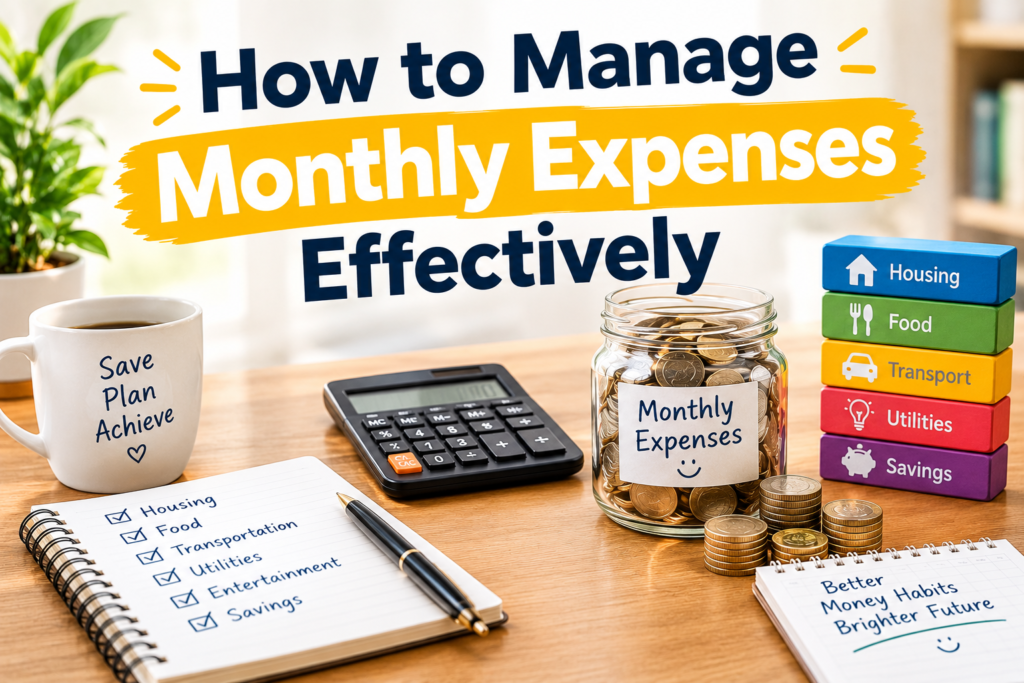
Managing monthly expenses effectively is an important part of maintaining a healthy financial routine. When you know where your money is going, it becomes easier to pay bills on time, avoid unnecessary spending, save for future goals, and prepare for unexpected costs.
Many people struggle with monthly expenses not because they do not earn enough, but because their spending is not organized. Small purchases, recurring subscriptions, unexpected bills, and lifestyle expenses can gradually consume a large portion of income.
The good news is that managing expenses does not require complicated financial systems. A clear budget, regular tracking, realistic spending limits, and a few consistent habits can make monthly money management much easier.
What Are Monthly Expenses?
Monthly expenses are the costs you regularly pay during a month. Some expenses remain almost the same each month, while others change depending on your usage and spending habits.
Common monthly expenses include:
- Housing
- Groceries
- Utilities
- Transportation
- Insurance
- Debt payments
- Phone bills
- Internet
- Entertainment
- Dining out
- Household supplies
- Personal spending
Understanding these categories is the first step toward creating a system that keeps your expenses under control.
Step 1: Calculate Your Monthly Income
Before managing your expenses, determine how much money you have available.
If you receive a regular salary, use your take-home income after taxes and other deductions.
If you have multiple income sources, add the amounts you reasonably expect to receive.
For example:
| Income Source | Monthly Amount |
|---|---|
| Salary | $3,000 |
| Freelance Work | $300 |
| Other Income | $200 |
| Total | $3,500 |
| If your income changes each month, consider using a conservative estimate rather than your highest possible income. | |
| This helps create a budget that remains practical during lower-income months. |
Step 2: Track Every Expense
The next step is to understand where your money is actually going.
Track every expense for at least one month. Include large bills as well as small purchases.
You can use:
- A spreadsheet
- A budgeting application
- A notebook
- A phone notes app
- Bank and credit-card statements
Record expenses as soon as possible so you do not forget them.
After several weeks, you will begin to see patterns in your spending.
Step 3: Separate Fixed and Variable Expenses
One of the easiest ways to organize your monthly expenses is to divide them into fixed and variable costs.
Fixed Expenses
Fixed expenses generally stay the same or close to the same each month.
Examples include:
- Rent or mortgage
- Car payments
- Insurance
- Loan payments
- Internet
- Certain subscriptions
Variable Expenses
Variable expenses can change from month to month.
Examples include:
- Groceries
- Electricity
- Fuel
- Dining out
- Entertainment
- Clothing
- Household purchases
Knowing which expenses are fixed and which are flexible helps you identify where adjustments are possible.
Step 4: Separate Needs From Wants
Not every expense has the same level of importance.
Needs are expenses required for basic living or important financial obligations. Wants are expenses that improve your lifestyle but can usually be reduced or postponed.
For example:
Needs
- Housing
- Basic food
- Utilities
- Necessary transportation
- Essential healthcare
- Required debt payments
Wants
- Restaurant meals
- Entertainment
- Premium subscriptions
- Expensive hobbies
- Non-essential shopping
This does not mean that wants should disappear from your budget. Instead, it helps you understand which expenses can be adjusted if you need to save more money.
Step 5: Create a Monthly Expense List
Create one list containing all expected expenses for the upcoming month.
For example:
| Expense | Planned Amount |
|---|---|
| Housing | $900 |
| Groceries | $350 |
| Utilities | $150 |
| Transportation | $180 |
| Insurance | $150 |
| Phone and Internet | $100 |
| Debt Payments | $250 |
| Entertainment | $100 |
| Personal Spending | $120 |
| Savings | $400 |
| Miscellaneous | $100 |
| Total | $2,800 |
| If your income is $3,000, this example leaves $200 available for additional savings, debt repayment, or other priorities. |
Step 6: Set Spending Limits
Once you know your expenses, establish a maximum amount for flexible categories.
For example, you could set:
- Groceries: $350
- Dining out: $100
- Entertainment: $75
- Personal spending: $100
- Shopping: $75
Spending limits are most useful when they are realistic.
If you normally spend $400 on groceries, immediately setting a $150 limit may not be practical. Instead, identify ways to gradually reduce spending while keeping the target achievable.
Step 7: Plan for Bills Before They Are Due
Late bills can create unnecessary fees and financial stress.
Create a monthly bill calendar showing:
- Bill name
- Amount
- Due date
- Payment method
For example:
| Bill | Amount | Due Date |
|—|—:|—|
| Rent | $900 | 1st |
| Internet | $60 | 5th |
| Insurance | $150 | 10th |
| Electricity | $100 | 15th |
| Phone | $40 | 20th |
Knowing your due dates allows you to make sure enough money is available when payments are required.
Step 8: Automate Regular Payments
If your bank or service provider supports automatic payments, you can automate bills that have predictable amounts or payment schedules.
Automation can reduce the chance of forgetting a payment.
However, continue checking your account regularly to ensure there is enough money available and that charges are accurate.
Automatic payments are a convenience, not a replacement for reviewing your finances.
Step 9: Reduce Unnecessary Subscriptions
Subscriptions can be easy to forget because each individual payment may seem small.
Review all recurring charges and ask:
- Do I use this service regularly?
- Does it provide enough value?
- Do I have multiple services that perform similar functions?
- Could I use a less expensive option?
For example, reducing three unused subscriptions by $15 each could save $45 per month, or $540 per year.
Step 10: Control Grocery Spending
Groceries are an essential expense, but there may still be opportunities to manage the cost.
Consider:
- Planning meals before shopping
- Creating a shopping list
- Checking what you already have
- Comparing prices
- Buying appropriate quantities
- Reducing food waste
- Preparing meals at home
Avoiding unnecessary purchases can make a noticeable difference over time.
However, the goal is not simply to buy the cheapest food. Focus on balancing cost, nutrition, quality, and your household’s needs.
Step 11: Manage Dining and Takeout Expenses
Dining out and food delivery can become significant monthly expenses.
Instead of eliminating them completely, set a specific monthly limit.
For example, if you currently spend $200 per month on restaurants, you might set a target of $125.
This creates room for enjoyment while keeping the expense within your overall financial plan.
Step 12: Review Transportation Costs
Transportation can include fuel, public transportation, vehicle payments, insurance, parking, and maintenance.
Review the total monthly cost rather than looking only at the fuel bill.
You may be able to reduce transportation expenses by:
- Combining errands
- Using public transportation when practical
- Carpooling
- Comparing insurance options
- Maintaining your vehicle regularly
- Avoiding unnecessary trips
Small changes can reduce recurring transportation costs over time.
Step 13: Create a Miscellaneous Category
No monthly budget can predict every expense perfectly.
A miscellaneous category gives you some flexibility for small unexpected costs.
For example, you might set aside $100 each month.
This money could cover:
- Household replacements
- Small repairs
- Unexpected fees
- Minor medical expenses
- Other unplanned necessities
If you do not use the money, you can transfer it to savings or another financial goal.
Step 14: Plan for Irregular Expenses
Some expenses do not occur every month but should still be included in your financial plan.
Examples include:
- Vehicle repairs
- Annual insurance
- School expenses
- Holiday spending
- Property taxes
- Home maintenance
- Annual memberships
Estimate the yearly cost and divide it by 12.
If you expect $1,200 in annual irregular expenses, saving $100 per month can help prepare for those costs.
Step 15: Use the 24-Hour Rule for Non-Essential Purchases
A simple way to control impulse spending is to wait before making non-essential purchases.
For smaller purchases, wait 24 hours.
For larger purchases, consider waiting several days or longer.
During the waiting period, ask yourself:
- Do I need this?
- Did I plan for it?
- Can I afford it without affecting important goals?
- Is there a less expensive alternative?
This pause can prevent many unnecessary purchases.
Step 16: Compare Planned and Actual Spending
At the end of each month, compare what you planned to spend with what you actually spent.
For example:
| Category | Planned | Actual | Difference |
|---|---|---|---|
| Groceries | $350 | $375 | -$25 |
| Transportation | $180 | $160 | +$20 |
| Entertainment | $100 | $75 | +$25 |
| Shopping | $75 | $120 | -$45 |
| Savings | $400 | $400 | $0 |
| This comparison helps identify categories that consistently exceed their limits. |
Step 17: Find Your Biggest Spending Categories
Look at your monthly spending and identify the categories that consume the most money.
For many households, housing, transportation, food, and debt payments may represent significant portions of the budget.
Reducing a major expense can sometimes have a larger effect than cutting many tiny expenses.
For example, reducing a recurring $100 monthly expense saves $1,200 per year.
This is why it is useful to look at both small purchases and major recurring costs.
Step 18: Avoid Unplanned Lifestyle Upgrades
When income increases, it can be tempting to increase spending immediately.
You might upgrade your vehicle, move into more expensive housing, or increase entertainment spending.
Some upgrades may be worthwhile, but recurring expenses can quickly reduce the financial benefit of a higher income.
Before adding a new monthly expense, consider how it will affect your savings and other financial goals.
Step 19: Use Extra Income Carefully
Occasionally, you may receive income outside your regular paycheck.
Examples include:
- Bonuses
- Freelance payments
- Business profits
- Gifts
- Refunds
- Temporary work
Rather than automatically spending all additional income, consider assigning part of it to savings, debt repayment, or upcoming expenses.
This can help improve your financial position without requiring a permanent reduction in your normal spending.
Step 20: Build an Emergency Fund
An emergency fund can help protect your monthly budget when an unexpected financial problem occurs.
Without an emergency fund, a major repair or unexpected bill may require credit or borrowing.
Start with a manageable target and increase it over time.
Keep emergency savings separate from money intended for everyday spending so that it is easier to preserve for genuine emergencies.
Common Monthly Expense Management Mistakes
Not Tracking Small Purchases
Small purchases can add up quickly, especially when repeated throughout the month.
Forgetting Annual Bills
An annual expense can become a major problem if it is not included in your financial planning.
Setting Unrealistic Budgets
A spending limit should be challenging but achievable.
Ignoring Recurring Charges
Review subscriptions and automatic payments regularly.
Spending Before Saving
If saving is important, include it in your monthly plan before optional spending.
Failing to Review Your Budget
Your expenses and income can change. A budget should be updated when your circumstances change.
What to Do When Monthly Expenses Are Too High
If your monthly expenses are consistently higher than your income, start by identifying the categories causing the largest problems.
Review:
- Housing costs
- Transportation
- Debt payments
- Food expenses
- Subscriptions
- Entertainment
- Shopping
- Other recurring charges
Focus first on expenses that are flexible or can be changed without creating additional problems.
You can also look for ways to increase income when practical. The goal is to create a sustainable monthly plan rather than relying on temporary fixes.
A Simple Monthly Expense Management Routine
A simple routine can make managing expenses much easier.
At the Beginning of the Month
Review your expected income and upcoming bills.
Set spending limits for flexible categories and decide how much you want to save.
During the Month
Track expenses as they occur.
Check your spending categories regularly so you know whether you are approaching your limits.
At the End of the Month
Compare planned and actual spending.
Identify categories that need adjustment and move unused money toward savings or another priority.
Repeating this process each month can turn budgeting into a normal financial habit.
How to Make Expense Management Easier
Keep your financial system simple.
You do not need dozens of categories if they make your budget difficult to maintain.
A basic system might include:
- Housing
- Food
- Transportation
- Utilities
- Debt
- Savings
- Personal spending
- Entertainment
- Miscellaneous
Use whichever categories make sense for your household.
The best system is one that you can consistently maintain.
Final Thoughts
Managing monthly expenses effectively starts with understanding your income and knowing exactly where your money goes. Once you track your spending, separate fixed and variable expenses, distinguish needs from wants, and create realistic spending limits, it becomes easier to make informed financial decisions.
Planning for irregular expenses, reviewing recurring subscriptions, automating important payments, and building emergency savings can provide additional protection for your monthly budget.
You do not need to make every financial change at once. Start by tracking your expenses, identify the areas that need attention, and make gradual improvements. Review your results each month and adjust your plan as your income, expenses, and financial goals change.
A well-organized monthly expense plan can give you a clearer picture of your finances and make it easier to balance everyday spending with future financial goals.
