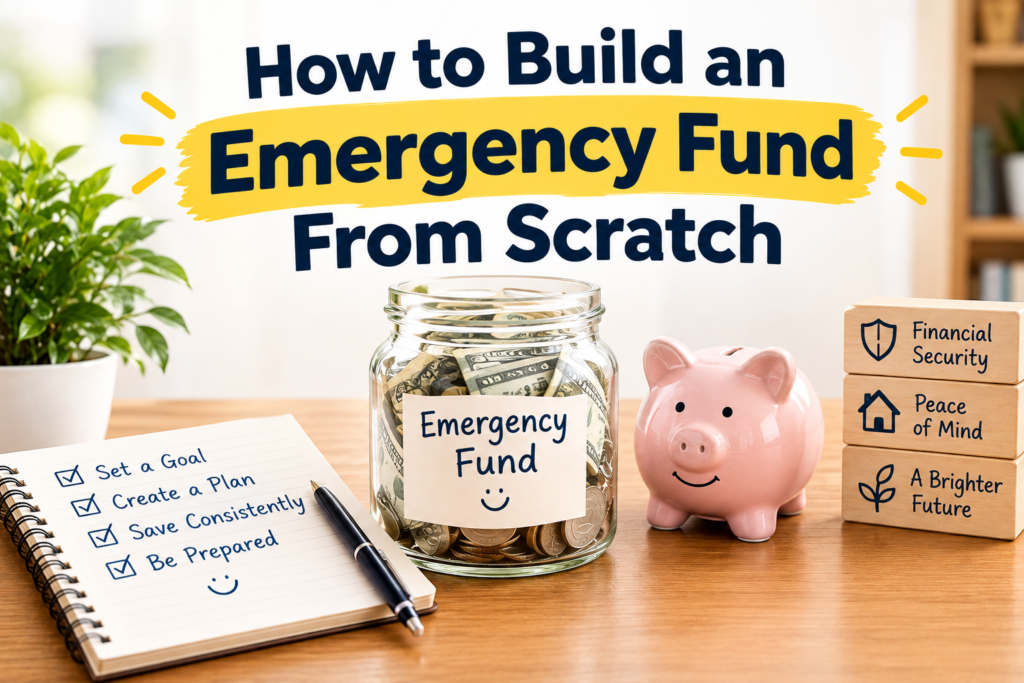
An emergency fund is money set aside for unexpected and necessary expenses. It can help you handle financial surprises without immediately relying on credit cards, loans, or money intended for other goals.
Unexpected expenses can happen at any time. A vehicle may need an urgent repair, a household appliance may stop working, or your income may temporarily decrease. Having money available for these situations can provide a financial cushion and make unexpected costs easier to manage.
Building an emergency fund from scratch may seem difficult, especially when your monthly budget is already tight. However, you do not need to build the entire fund immediately. Starting with a small amount and contributing consistently can help you gradually create a useful financial reserve.
What Is an Emergency Fund?
An emergency fund is a dedicated amount of money reserved for unexpected and necessary financial needs.
Examples of situations that may require emergency savings include:
- Unexpected vehicle repairs
- Necessary medical expenses
- Urgent home repairs
- Temporary loss of income
- Emergency travel
- Essential household replacements
- Unexpected bills
The purpose of an emergency fund is to provide accessible money when a genuine financial emergency occurs.
Why Is an Emergency Fund Important?
Without emergency savings, an unexpected expense can disrupt your entire monthly budget.
For example, imagine that your car suddenly requires a $600 repair. If you do not have savings available, you may need to use a credit card, borrow money, or delay another important payment.
An emergency fund gives you another option.
It can help you:
- Handle unexpected expenses
- Reduce reliance on high-cost borrowing
- Protect money saved for other goals
- Maintain greater financial flexibility
- Recover more easily from unexpected events
The goal is not to predict every emergency. The goal is to prepare financially for expenses you cannot predict.
Step 1: Determine Your Essential Monthly Expenses
Before deciding how large your emergency fund should be, calculate your essential monthly expenses.
Focus on costs that are necessary to maintain basic living.
These may include:
- Housing
- Basic groceries
- Utilities
- Transportation
- Insurance
- Essential healthcare
- Required debt payments
- Necessary household expenses
For example:
| Essential Expense | Monthly Amount |
|—|—:|
| Housing | $900 |
| Groceries | $350 |
| Utilities | $150 |
| Transportation | $180 |
| Insurance | $150 |
| Debt Payments | $200 |
| Other Essentials | $120 |
| Total | $2,050 |
This gives you a starting point for estimating how much emergency savings may be appropriate for your circumstances.
Step 2: Choose Your Initial Emergency Fund Target
You do not have to begin with a large target.
If you currently have no emergency savings, choose a smaller initial milestone.
For example:
- First target: $250
- Second target: $500
- Third target: $1,000
- Later target: Several months of essential expenses
The appropriate final amount depends on factors such as income stability, household responsibilities, necessary expenses, access to other resources, and job security.
Starting with a smaller target can make the process feel more achievable.
Step 3: Open a Separate Savings Account
Consider keeping your emergency fund separate from the account you use for everyday spending.
A separate account can make it easier to see how much you have saved and reduce the temptation to spend the money casually.
Look for an account that provides convenient access when you actually need the money while keeping the funds separate from your regular spending.
Step 4: Start With a Small Amount
If you cannot afford to save hundreds of dollars each month, start smaller.
For example, you could save:
- $10 per week
- $25 per week
- $50 per month
- $100 per month
The exact amount is less important than creating a contribution that fits your budget.
Saving $25 per week would result in approximately $1,300 over a year if you consistently make all 52 weekly contributions.
Step 5: Automate Your Contributions
Automatic transfers can make building an emergency fund easier.
If your bank supports automatic transfers, schedule money to move into your emergency savings after your income arrives.
For example, if you decide to save $100 per month, schedule a $100 transfer every month.
Automation reduces the need to remember to save manually and can turn emergency-fund contributions into a regular financial habit.
Step 6: Treat Emergency Savings as a Budget Expense
Instead of saving only when you have extra money, include emergency savings in your monthly budget.
For example:
| Monthly Income | Amount |
|---|---|
| Income | $3,000 |
| Essential Expenses | $2,050 |
| Emergency Fund | $200 |
| Other Savings | $200 |
| Flexible Spending | $550 |
| This is only an example. Your actual numbers should reflect your own income and expenses. | |
| The important idea is to give emergency savings a specific place in your monthly plan. |
Step 7: Look for Expenses You Can Reduce
Review your current spending and identify areas that can be reduced temporarily while you build your emergency fund.
Potential areas include:
- Dining out
- Entertainment
- Unused subscriptions
- Impulse shopping
- Expensive convenience purchases
- Non-essential services
You do not have to eliminate everything you enjoy.
For example, reducing discretionary spending by $50 per month and redirecting that money to your emergency fund would add $600 over one year.
Step 8: Use Extra Income to Boost Your Fund
Extra income can help you reach your emergency savings target faster.
Possible sources include:
- Overtime
- Freelance work
- Bonuses
- Temporary work
- Selling unused items
- Business income
- Other legitimate additional income
You do not necessarily need to put every extra dollar into savings. You could allocate a portion to your emergency fund while using the remainder for other financial priorities.
Step 9: Save Part of Unexpected Money
Sometimes you may receive money that you were not expecting.
Examples include:
- A cash gift
- A refund
- A work bonus
- A tax refund
- Proceeds from selling unused items
Instead of immediately spending all of it, consider directing part of the money toward your emergency fund.
Even occasional contributions can help accelerate progress.
Step 10: Decide What Counts as an Emergency
One of the most important parts of building an emergency fund is understanding when you should use it.
A genuine emergency is generally an unexpected and necessary expense that cannot reasonably be handled through your normal monthly budget.
Examples may include:
- An urgent car repair needed for transportation
- An unexpected essential medical expense
- A necessary home repair
- A sudden temporary reduction in income
On the other hand, planned purchases, entertainment, routine shopping, and ordinary monthly bills generally belong in your regular budget rather than your emergency fund.
Step 11: Avoid Using the Fund for Everyday Spending
An emergency fund works best when it remains available for actual emergencies.
If you regularly withdraw money for restaurants, shopping, vacations, or entertainment, it becomes difficult to build a lasting financial cushion.
Create separate savings categories for planned purchases whenever possible.
For example:
- Emergency Fund
- Vacation Fund
- Car Maintenance Fund
- Home Repair Fund
- Annual Expenses Fund
This separation can make it easier to protect your emergency savings.
Step 12: Plan for Irregular Expenses Separately
Not every large expense is an emergency.
If you know that your car will require maintenance, your insurance will renew, or you will need to purchase school supplies, these costs can often be planned for in advance.
Create separate savings categories for predictable expenses.
For example:
| Goal | Monthly Saving |
|---|---|
| Emergency Fund | $150 |
| Car Maintenance | $75 |
| Annual Bills | $50 |
| Vacation | $50 |
| Total | $325 |
| This approach prevents predictable expenses from repeatedly draining your emergency fund. |
Step 13: Build the Fund in Stages
Trying to save a large amount immediately can feel overwhelming.
Instead, use milestones.
Milestone 1: $250
This can provide a small initial cushion.
Milestone 2: $500
This gives you more flexibility for smaller unexpected expenses.
Milestone 3: $1,000
This can provide a larger buffer for certain emergencies.
Milestone 4: Several Months of Essential Expenses
Once you have established the habit, you can work toward a larger reserve based on your personal circumstances.
These milestones are examples, not universal requirements. Your appropriate target may be different.
Step 14: Adjust Your Savings When Your Income Changes
If your income increases, consider increasing your emergency-fund contribution.
For example, if you currently save $100 per month and receive a permanent $300 monthly increase in income, you might increase your savings contribution to $150 or $200.
You can still use some of the additional income for other priorities.
The goal is to allow your emergency savings to grow as your financial capacity improves.
Step 15: Rebuild the Fund After Using It
If you need to use your emergency fund, do not consider the process a failure.
That is exactly what emergency savings are designed for.
After the emergency is resolved, return to your regular savings plan.
For example, if your emergency fund falls from $2,000 to $800 after an unexpected repair, you can temporarily prioritize rebuilding it until it reaches your chosen target again.
The important part is to restart contributions rather than abandoning the fund.
Step 16: Keep Your Emergency Money Accessible
Emergency savings should generally be available when you genuinely need them.
Avoid placing emergency money somewhere that makes access unnecessarily difficult or exposes the funds to risks that are inconsistent with your need for a financial cushion.
The specific account or financial product you choose depends on your country, banking options, access requirements, and personal circumstances.
Step 17: Avoid Taking Unnecessary Risks With Emergency Savings
The main purpose of emergency savings is financial stability and accessibility.
Because emergencies can happen unexpectedly, money intended for this purpose should generally not be treated the same way as long-term investment money.
Your emergency fund has a different job from retirement or long-term investment savings.
Keeping these purposes separate can make your overall financial plan easier to manage.
Step 18: Keep Your Emergency Fund Separate From Long-Term Goals
It can be tempting to combine all your savings into one account.
However, separating goals can make your financial progress easier to understand.
For example:
| Account or Goal | Purpose |
|---|---|
| Emergency Fund | Unexpected necessary expenses |
| Short-Term Savings | Planned purchases |
| Annual Expenses | Predictable yearly costs |
| Retirement | Long-term financial planning |
| Other Goals | Specific future objectives |
| This structure helps prevent you from accidentally using money intended for one purpose to pay for another. |
Step 19: Review Your Emergency Fund Regularly
Your emergency-fund target should not necessarily remain the same forever.
Your expenses may increase, your income may change, or your household responsibilities may become different.
Review your emergency savings at least once or twice a year.
Ask:
- Have my essential expenses changed?
- Has my income changed?
- Do I have new financial responsibilities?
- Is my current emergency-fund target still appropriate?
- Have I used any of the savings recently?
Regular reviews help ensure that your emergency fund continues to match your circumstances.
Step 20: Make Emergency Savings Part of Your Financial Routine
Building an emergency fund is not a one-time task.
It is a financial habit.
Once you reach your initial target, continue monitoring the account and replenish it whenever necessary.
You can also redirect some of the money you were using to build the fund toward other financial goals after reaching an appropriate reserve.
The goal is to create a system that protects your finances while allowing you to continue working toward other priorities.
Common Emergency Fund Mistakes to Avoid
Waiting Until You Can Save a Large Amount
Starting small is better than waiting indefinitely for the perfect opportunity.
Using the Fund for Non-Essential Purchases
Protect the account for genuine emergencies.
Forgetting About Predictable Expenses
Plan separately for expenses that you know are coming.
Stopping After Reaching the First Milestone
Continue evaluating whether your emergency fund is sufficient for your circumstances.
Using Long-Term Investments as Your First Emergency Resource
Emergency savings and long-term investments serve different purposes.
Not Rebuilding After a Withdrawal
If you use your emergency savings, make rebuilding the fund a financial priority afterward.
What If You Have Debt?
If you have debt, you may wonder whether you should save money or focus entirely on debt repayment.
The answer can depend on the type of debt, interest rate, income stability, minimum payments, and your overall financial situation.
Maintaining some emergency savings can help prevent a small unexpected expense from creating additional debt.
At the same time, high-cost debt may require significant attention because interest can make balances grow quickly.
A practical plan may involve building an initial emergency cushion while continuing required debt payments, then directing additional money toward your highest-priority financial goals.
A Simple Emergency Fund Plan
Here is an example of how someone could build an emergency fund gradually:
| Month | Monthly Contribution | Total Saved |
|---|---|---|
| January | $100 | $100 |
| February | $100 | $200 |
| March | $150 | $350 |
| April | $150 | $500 |
| May | $150 | $650 |
| June | $200 | $850 |
| July | $200 | $1,050 |
| August | $200 | $1,250 |
| September | $200 | $1,450 |
| October | $200 | $1,650 |
| November | $200 | $1,850 |
| December | $200 | $2,050 |
| This is only an example. Your contribution can be smaller or larger depending on your financial circumstances. |
How to Stay Consistent
Consistency is often more important than making large contributions occasionally.
Choose an amount that fits your budget and automate it if possible.
You can also track your progress visually.
For example, if your target is $2,000, divide the goal into smaller milestones:
- $250
- $500
- $750
- $1,000
- $1,500
- $2,000
Each milestone shows that you are moving closer to your target.
Final Thoughts
Building an emergency fund from scratch may take time, but you do not need to create the entire fund immediately. Start by calculating your essential expenses, choosing a realistic initial target, opening a separate savings account, and contributing a manageable amount regularly.
Automating your contributions, reducing unnecessary expenses, using part of extra income, and planning separately for predictable costs can help your emergency savings grow steadily.
Remember that the appropriate size of an emergency fund depends on your personal circumstances. Someone with stable income and low essential expenses may have different needs from someone with variable income or significant household responsibilities.
The most important step is to begin. Even a small emergency fund can be a useful starting point, and you can increase it as your income, budget, and financial situation allow.
