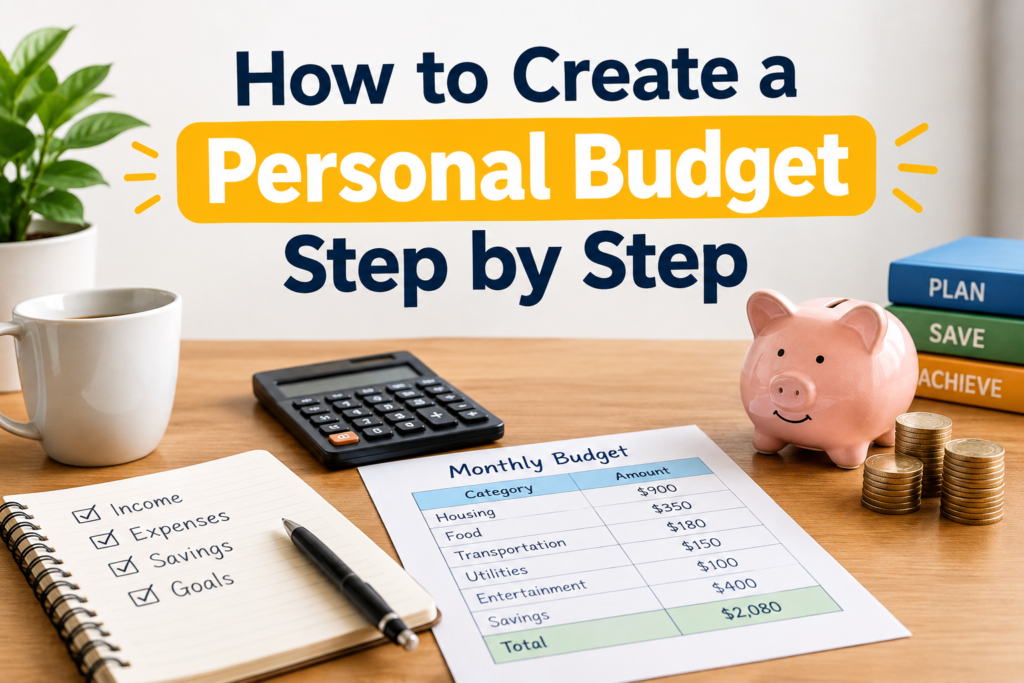
Creating a personal budget is one of the simplest ways to take control of your money. A budget helps you understand where your income goes, plan for important expenses, reduce unnecessary spending, and work toward financial goals. You do not need complicated financial software or advanced mathematics to create one. A basic budget can be built with your income, regular expenses, savings goals, and a little consistency.
Many people avoid budgeting because they believe it means giving up everything they enjoy. In reality, a good budget is not about preventing you from spending money. It is about deciding in advance how you want to use your money so that your spending supports your priorities.
Whether you earn a fixed salary, work freelance, run a small business, or have an irregular income, the following steps can help you create a practical personal budget.
What Is a Personal Budget?
A personal budget is a plan for how you will use your money during a specific period, usually one month. It compares your expected income with your expected expenses and savings.
A simple budget can be divided into four areas:
- Income: Money you expect to receive.
- Essential expenses: Costs you need to pay, such as housing, utilities, food, transportation, and basic healthcare.
- Non-essential expenses: Spending that improves your lifestyle but is not necessary for basic living.
- Savings and financial goals: Money you set aside for emergencies, future purchases, debt repayment, investing, or other goals.
The purpose is to make sure your money has a clear purpose before you spend it.
Step 1: Determine Your Monthly Income
The first step is to calculate how much money you actually have available each month.
If you receive a regular salary, this may be relatively easy. Use your take-home income rather than your gross salary if taxes and other deductions are already removed from your paycheck.
For example, suppose your monthly take-home income is $3,000. That $3,000 is the amount you can use to plan your monthly spending and savings.
If you have multiple income sources, add them together. Your income might include:
- Salary
- Freelance payments
- Business income
- Rental income
- Side-job income
- Regular commissions
- Other predictable sources of money
If your income changes from month to month, avoid building your budget around your highest-earning month. Instead, use a conservative estimate based on your typical or lower monthly income.
This gives your budget some flexibility when your income is smaller than expected.
Step 2: Track Your Spending
Before deciding how much you should spend in each category, find out where your money is currently going.
Track every expense for at least one month. You can use a spreadsheet, notebook, budgeting app, or simple notes on your phone.
Record both large and small purchases.
For example:
| Expense | Amount |
|---|---|
| Rent | $900 |
| Groceries | $350 |
| Transportation | $180 |
| Utilities | $150 |
| Phone | $60 |
| Dining out | $120 |
| Entertainment | $80 |
| Shopping | $100 |
| Small purchases can easily become significant when added together. A few inexpensive purchases each week may represent hundreds of dollars over several months. | |
| The purpose of tracking is not to judge yourself. It is to understand your actual spending habits. |
Step 3: Separate Needs From Wants
Once you know where your money is going, divide your expenses into needs and wants.
Needs
Needs are expenses required for basic living or important financial obligations.
Examples include:
- Housing
- Basic groceries
- Utilities
- Transportation
- Insurance
- Required debt payments
- Essential healthcare
- Necessary household expenses
Wants
Wants are expenses that you could reduce, postpone, or eliminate if necessary.
Examples include:
- Restaurant meals
- Streaming subscriptions
- Expensive clothing
- Entertainment
- Hobbies
- Non-essential shopping
- Premium services
- Impulse purchases
This distinction does not mean that wants are bad. Enjoyment is part of a healthy financial life. The goal is simply to understand which expenses are flexible when your budget becomes tight.
Step 4: List Your Fixed Expenses
Fixed expenses generally remain similar from month to month.
Examples include:
- Rent or mortgage
- Car payments
- Insurance premiums
- Internet bills
- Subscription services
- Certain loan payments
Write down each fixed expense and its monthly amount.
For example:
| Fixed Expense | Monthly Cost |
|—|—:|
| Housing | $900 |
| Car Payment | $300 |
| Insurance | $150 |
| Internet | $60 |
| Subscriptions | $40 |
| Total | $1,450 |
Knowing your fixed expenses tells you how much of your income is already committed before you begin planning flexible spending.
Step 5: Estimate Variable Expenses
Variable expenses can change from month to month.
Common examples include:
- Groceries
- Electricity
- Fuel
- Dining out
- Clothing
- Entertainment
- Household supplies
Look at your previous spending to create realistic estimates.
If you spent $300 on groceries in one month and $400 in another, setting a budget of $150 may not be realistic unless you have a specific plan to reduce your grocery costs.
A budget should challenge you without being impossible to follow.
Step 6: Decide How Much to Save
Savings should be part of your budget rather than something you do only when money is left over.
A common approach is to choose a specific savings amount or percentage of your income.
For example, if you earn $3,000 per month and decide to save 10%, you would set aside $300.
Your savings could be divided among different goals:
- Emergency fund
- Short-term purchases
- Annual expenses
- Retirement
- Education
- Travel
- Home ownership
- Other financial goals
The appropriate amount depends on your income, expenses, debt, and goals. If you cannot save a large amount initially, start with an amount you can consistently maintain.
Even a small recurring contribution can help establish the habit of saving.
Step 7: Include Irregular Expenses
One common budgeting mistake is planning only for monthly bills.
Some expenses occur only a few times a year.
Examples include:
- Insurance renewals
- Vehicle maintenance
- Annual memberships
- School expenses
- Gifts
- Holidays
- Property taxes
- Medical expenses
- Home repairs
Suppose you expect to spend $600 on car maintenance and registration over the next year.
Instead of waiting for the bill to arrive, you could set aside approximately $50 per month.
This approach turns a large future expense into a smaller monthly budget item.
Step 8: Create Spending Categories
Now organize your budget into categories.
A simple monthly budget might look like this:
| Category | Planned Amount |
|---|---|
| Housing | $900 |
| Utilities | $150 |
| Groceries | $350 |
| Transportation | $180 |
| Insurance | $150 |
| Debt Payments | $250 |
| Personal Spending | $150 |
| Entertainment | $100 |
| Savings | $400 |
| Miscellaneous | $120 |
| Total | $2,750 |
| If your monthly income is $3,000, you would have $250 remaining. | |
| You could assign that money to savings, debt repayment, investments, upcoming expenses, or additional flexibility. | |
| The important point is that your total planned spending should not exceed your available income. |
Step 9: Choose a Budgeting Method
There is no single budgeting method that works for everyone.
Zero-Based Budget
A zero-based budget assigns every dollar of expected income a purpose.
For example:
Income: $3,000
Planned expenses and savings: $3,000
The goal is not necessarily to spend every dollar. Savings and debt payments can also receive assignments.
Percentage-Based Budget
Some people prefer to divide their income into broad percentages.
One commonly discussed framework is the 50/30/20 approach:
- 50% for needs
- 30% for wants
- 20% for savings and debt repayment
However, these percentages are guidelines rather than universal rules. Housing costs, income levels, family circumstances, and local living costs can make different allocations more realistic.
Envelope Method
The envelope method assigns spending limits to specific categories.
Historically, people used physical envelopes containing cash. Today, the same idea can be used digitally.
For example, you might set separate spending limits for:
- Groceries
- Transportation
- Entertainment
- Dining
- Personal spending
Once a category reaches its limit, you wait until the next budget period unless you deliberately move money from another category.
Step 10: Set Realistic Spending Limits
Avoid creating a budget that is so restrictive that you abandon it after a week.
If you normally spend $200 per month on dining out, immediately setting the limit at $20 may be unrealistic.
Instead, you might reduce it gradually.
For example:
Current spending: $200
New target: $150
Monthly reduction: $50
Once the new amount becomes comfortable, you can decide whether another reduction makes sense.
A sustainable budget is generally more useful than an extremely strict budget that cannot be maintained.
Step 11: Automate Your Savings
Automation can make budgeting easier.
If your bank allows automatic transfers, consider scheduling a transfer shortly after receiving your income.
For example, if you want to save $300 each month, an automatic transfer can move that amount into a dedicated savings account.
This reduces the need to make the decision manually every month.
It can also help prevent the situation where you spend your entire paycheck and then discover there is nothing left to save.
Step 12: Create a Small Miscellaneous Category
Unexpected expenses happen.
You might need to replace a household item, pay for a small repair, purchase medicine, or cover another expense that was not included in your original plan.
A miscellaneous category gives your budget some breathing room.
For example, you might allocate $100 per month for unexpected or miscellaneous spending.
If you do not use it, you can move the remaining money toward savings or another financial goal.
Step 13: Review Your Budget Every Month
A budget should not be created once and forgotten.
At the end of each month, compare your planned amounts with your actual spending.
Ask yourself:
- Did I spend more than expected?
- Which categories were higher?
- Which categories were lower?
- Did I save the amount I planned?
- Were there unexpected expenses?
- Can I adjust anything next month?
For example, if your grocery budget was $350 but you consistently spend $425, your budget may need to change—or you may need to identify ways to reduce grocery spending.
Budgeting is an ongoing process of adjustment.
Step 14: Reduce Unnecessary Expenses
Once you understand your spending, look for expenses that provide little value.
You may discover subscriptions you rarely use, frequent convenience purchases, unnecessary fees, or spending habits that no longer match your priorities.
Instead of cutting everything, focus on expenses that you do not value.
For example, canceling an unused $15 monthly subscription saves $180 per year.
Several small changes can produce meaningful results over time.
Step 15: Give Every Financial Goal a Deadline
A budget becomes more motivating when it connects spending decisions to specific goals.
Instead of saying:
“I want to save money.”
Create a specific goal:
“I want to save $2,400 for a car repair fund within 12 months.”
That means saving approximately $200 per month.
Specific goals make it easier to determine whether your current budget is working.
Common Budgeting Mistakes to Avoid
Ignoring Small Purchases
Small purchases can add up quickly. Track them just like larger expenses.
Setting Unrealistic Limits
A budget that does not reflect reality is difficult to maintain.
Forgetting Annual Expenses
Include expenses that occur quarterly, annually, or irregularly.
Treating Savings as Optional
If saving is important to you, include it as a planned part of your budget.
Never Reviewing the Budget
Your income and expenses can change. Review the budget regularly.
Using Credit Without Tracking It
Credit-card spending is still spending. Record purchases when they happen rather than waiting for the bill.
What to Do If Your Expenses Are Higher Than Your Income
If your budget shows that you are spending more than you earn, do not ignore the problem.
Start by reviewing your expenses.
Look for areas where you can:
- Reduce discretionary spending
- Cancel unused subscriptions
- Shop around for certain services
- Reduce dining-out costs
- Review transportation expenses
- Delay non-essential purchases
- Increase income through additional work when practical
You may also need to reconsider your financial goals temporarily.
The goal is to create a sustainable gap between income and expenses that can eventually support savings and other priorities.
How to Make Budgeting Easier
Budgeting becomes easier when you make it part of your routine.
Choose one day each month to review your finances. During that time, check your bank accounts, bills, savings, and spending.
You can also create a simple spreadsheet with columns for:
- Category
- Planned amount
- Actual amount
- Difference
For example:
| Category | Planned | Actual | Difference |
|—|—:|—:|—:|
| Groceries | $350 | $375 | -$25 |
| Transportation | $180 | $160 | +$20 |
| Entertainment | $100 | $70 | +$30 |
| Savings | $400 | $400 | $0 |
This makes it easy to identify patterns.
Final Thoughts
Creating a personal budget does not have to be complicated. Start by calculating your income, tracking your spending, separating needs from wants, listing fixed and variable expenses, and setting realistic savings goals.
The most important part is consistency. Your first budget will not necessarily be perfect. After tracking your actual spending and reviewing your results, you can make adjustments that better reflect your life.
A useful budget should give you a clearer understanding of your money while helping you prepare for future expenses and financial goals. Rather than viewing budgeting as a restriction, think of it as a plan that gives every part of your income a purpose.
Start with a simple monthly budget, review it regularly, and improve it as your financial situation changes. Over time, this routine can make managing your money more organized and predictable.
